
In February 2021, ADPH London released a position statement supporting Black, Asian and minority ethnic communities during and beyond the COVID-19 pandemic. This statement highlights racism as a public health issue, given the immediate and structural factors that have impacted these communities and it is vital that we develop approaches to take action. As part of ADPH London’s commitment to mitigate any further widening of inequalities between Black, Asian and minority ethnic communities and White British people, the position statement highlights the following five themes for action development:
- Trust and cohesion: We support the work of the wider system in recognising ethnic identity, being aware of the term ‘BAME’ and will focus on building trust and cohesion with communities, understanding what it is, and how we build and strengthen this.
- Improving ethnicity data collection and research: The programme will focus on improving ethnicity data collection and research, and exploring ethnic identity with communities and the wider system.
- Diversifying the workforce and encouraging systems leadership: Work is already taking place in the wider system with London Councils planning ethnicity pay reporting and race equality standards for London local authorities. Our plan will focus on public health recruitment and mentoring support for those from Black, Asian and minority ethnic backgrounds (entry to senior level).
- Co-production with communities: The programme will focus on supporting public health professionals and wider partners in understanding co-production and what good practice looks like.
- Embedding public health work in social and economic policy: We will focus on bringing our public health voice to raise awareness on structural racism in wider determinants including housing and employment.
Institute of Health Equity report on structural racism, ethnicity and health inequalities in London

This ground-breaking report by the Institute of Health Equity (IHE), published in September 2024, concludes that structural racism affects the health and wellbeing of ethnic minority group communities in London and leads to avoidable and unfair inequalities between ethnic groups. The review entitled Structural Racism, Ethnicity and Health Inequalities in London highlights how people who are repeatedly exposed to racism during their daily lives, or when using essential services, increasingly experience worse physical and mental health over time.
The report also acknowledges the many new and outstanding efforts to reduce racism in London, but found the impacts remain starkly evident, manifesting, particularly, in ethnic inequalities in poverty, housing, employment, pay and career progression.
IHE researchers also highlight the well-documented marked inequalities among ethnic groups in maternal and child health and mental illness, alongside experiences with the criminal justice system and healthcare services more widely.
The IHE is calling for greater accountability, particularly from leaders, institutions and employers to prevent racism from continuing unchecked and to improve the lives of people who experience it.
As a result, the review includes the following recommendations: –
- Ensure all employers pay the London Living Wage and eliminate inequalities in pay by ethnicity.
- Greater London Authority to develop and lead on anti-racism approach for all employers in London.
- Strengthen enforcement of legal requirements for non-discriminatory recruitment and support people into work and training by building co-designed programmes with affected groups.
- Reports on racism to be investigated by independent bodies not by employers.
Dr Sandra Husbands, and Dr Catherine Mbema, Co-chairs of the ADPH London; Public Health Tackling Racism & Inequality Programme said:
“We welcome this report and are pleased to see that it echoes the position statement released by ADPH London in February of 2021, which highlighted racism as a public health issue and made a commitment to develop approaches to take action.”
PHTR&I Podcast Series
Our programme has its own podcast where we interview some leading public health professionals on key themes of focus of our programme.
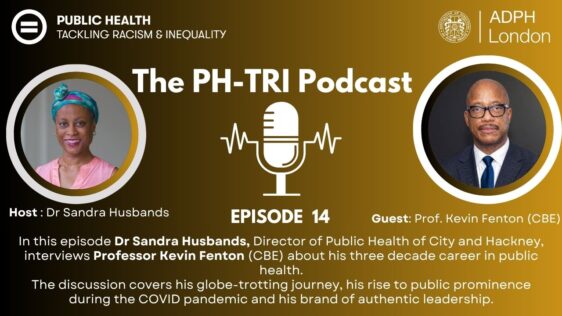
Previous guests and topics have included:
- Prof. Winston Morgan of the University of East London discussing a new treatment for Sickle Cell Anemia,
- Dr. Sharmin Shajahan of Voice For Change, England discussing the health of the Bangladeshi community
- Professor Frank Chinegwundoh sharing his expertise on the topic of prostate cancer.
- Jason Strelitz former Director of Public Health for Newham discussing his book on the COVID pandemic
- Mark Thompson lead commissioner for the London HIV Prevention Programme
- Dr John Licorish, Public Health Consultant in Brent discussing community outreach
The series is available to listen to on Spotify, Amazon Music and Apple podcasts.
Make sure to ‘Follow’ and future episodes will appear on your playlist automatically.
For more information on the Public Health Tackling Racism and Inequality programme, please get in touch with lee.pinkerton@cityandhackneyph.hackney.gov.uk
Research for the Trust & Cohesion workstream produces academic paper
The research paper Racism and Racial Health Inequity, is the first output from the Trust and Cohesion workstream.
Published in the Journal of Public Health at the start of 2026, the paper identifies four key social theories that are essential to combating racism and advancing racial health equity.
These theories emerged when the workstream engaged two anthropologists, Dr Caroline Parker and Professor Melissa Parker, to help develop their anti-racism strategy. Over the past year, they collaborated through discussions and critically examined literature in critical race theory, Black studies, race and ethnicity studies and the anthropology of white supremacy.
Together, these sources form a body of conceptual tools to help public health professionals dismantle racism and disparities.
You can access the full paper here.