London HIV Prevention Programme has only gone and Done It!
The London HIV Prevention Programme (LHPP) and its flagship Do It London campaign is celebrating a series of recent prestigious awards and shortlistings.
- Purpose Awards UK 2026 – Winner – Best Health Cause Campaign (Public Sector)
- The Drum Awards EMEA – Bronze – Social Purpose
- LGC Awards 2026 – Shortlisted for ‘Campaign of the Year’ and ‘Public & Private Partnership Award’ (announcement pending)
The London HIV Prevention Programme is a pan‑London collaboration funded and supported by all London local authorities, demonstrating the vital role of local government leadership in improving population health outcomes. By pooling resources and expertise, London’s boroughs have created a programme that reaches communities at scale, drives innovation, and delivers measurable impact in reducing HIV transmission and stigma.
The current phase of the Do It London campaign, relaunched in 2025, was developed in response to evolving evidence about HIV in the capital and a need to reach a broader cross‑section of Londoners. While earlier phases of the programme had successfully driven awareness and behaviour change — particularly among gay, bisexual and men who have sex with men — more recent data highlighted persistent stigma, unequal access to prevention, and lower engagement among other communities, including heterosexual Londoners and Black African communities.
Research underpinning the 2025 campaign found that many Londoners did not see HIV as relevant to them, with as many as 50–75% disengaging from traditional HIV messaging due to perceptions that it only applied to specific groups. This insight drove a fundamental shift in approach. In response, the London HIV Prevention Programme undertook a major campaign refresh in 2025, led by behavioural insight, community engagement, and co‑production with Londoners. The relaunch introduced a new unifying message — “London: let’s prevent HIV together” — designed to position HIV prevention as a shared, city-wide responsibility.
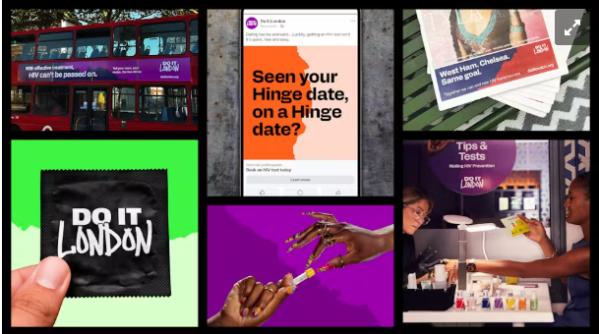
The updated campaign deliberately moved HIV prevention messaging into mainstream cultural spaces and everyday settings, using bold, relatable creative rooted in London life — from high streets to social media — to normalise conversations and reduce stigma. This included innovative activations such as community partnerships and culturally relevant outreach designed to embed HIV prevention within everyday routines.
At its core, the 2025 campaign was built to:
- Broaden relevance beyond traditionally targeted groups
- Normalise HIV prevention as part of everyday self-care
- Challenge stigma and misconceptions
- Promote the four key prevention methods: testing, condoms, PrEP and U=U
This strategic reset has driven the campaign’s recent success—delivering a 282% increase in HIV self‑test kit orders—demonstrating strong engagement and behaviour change among Londoners, and highlighting the value of sustained investment by London’s Directors of Public Health in achieving measurable outcomes and accelerating progress towards ending new HIV transmissions by 2030.
“These awards reflect the power of collaboration across London. By working with communities and partners, we are sustaining and building the capital’s collective HIV prevention work, making real progress towards ending new HIV infections.”