
Public Health Intelligence
The South West Public Health Intelligence (PHI) Practice Improvement Programme is a regional priority within the South West Practice Improvement Programme, initiated by South West Directors of Public Health. The work focuses on strengthening how PHI teams within local authorities are structured, operate and support their wider local systems, while fostering greater consistency, collaboration and impact across the region.
The key aims of the programme are to:
- Develop a shared understanding of PHI team structures, functions and capacity across the region
- Explore how PHI teams support local decision‑making and system leadership
- Strengthen alignment between local, regional and national intelligence functions
- Build a shared evidence base of best practice and “what good looks like”
- Identify opportunities to improve consistency, collaboration and sustainability of PHI services

Public Health Intelligence Assessment Tool and Early Findings
A comprehensive regional PHI survey was developed by the working group and then completed by all South West local authorities, achieving a 100% response rate. The survey provided valuable insight into workforce models, analytical capability, access to data, partnership arrangements and perceived impact.
Key findings highlighted:
- Strong, skilled and highly committed PHI teams and individuals across the South West
- High and growing demand for PHI services, placing pressure on comparatively small teams
- Significant variation in team size, roles, governance models and access to local and national datasets
- Strong leadership and analytical expertise, alongside opportunities to improve co‑production, data architecture and consistency
Workshops and Collaborative Learning
The findings were explored further through a series of regional workshops, including a SWINPHO Analysis Community event jointly led by Simon Chant and Simon Packer, with support from colleagues in the Local Knowledge and Intelligence Service (LKIS).
These workshops brought together PHI leads, analysts, consultants and system partners to:
- Reflect on survey results using both quantitative analysis and qualitative insight
- Share innovative and impactful examples of PHI practice from each local authority
- Explore the benefits and challenges of current arrangements
- Begin shaping regional improvement priorities and collective actions
Break‑out discussions focused on four key themes:
Team Structure
- What job‑structure information is most useful to share regionally
- The visibility and clarity of analyst development pathways
- Additional support needed to strengthen workforce development
Function and Impact
- How to more systematically share good practice across teams
- How to increase impact in areas such as data architecture and co‑production
- What else is needed to maximise the contribution of PHI to system decision‑making
Relationships
- Which system relationships are most important to strengthen
- Barriers to cross‑team and cross‑system collaboration
- How existing networks and partnerships can be better leveraged
Data Access
- Key barriers to accessing local and national data
- The value of a baseline standard for data access across the region
- How best to share data access routes, intelligence products and approaches
Showcasing Innovation and Best Practice
Each South West local authority contributed a case study showcasing innovative and impactful PHI work. These examples span a wide range of themes, including system leadership, population insights, partnership working and applied analytics, and collectively help to build a regional picture of high‑quality practice.
Influencing with Intelligence: Understanding and Strengthening the Role of Public Health Intelligence Through Practice Improvement in the South West Final Report
The workshops generated a strong, shared sense of direction and informed a programme of work that has now progressed to delivery. A final regional Public Health Intelligence report has been drafted and shared, drawing together survey findings, workshop insight and local authority case studies to articulate a clear set of regional recommendations.
The report provides a clear picture of how PHI functions operate across the South West and how they can be strengthened collectively.
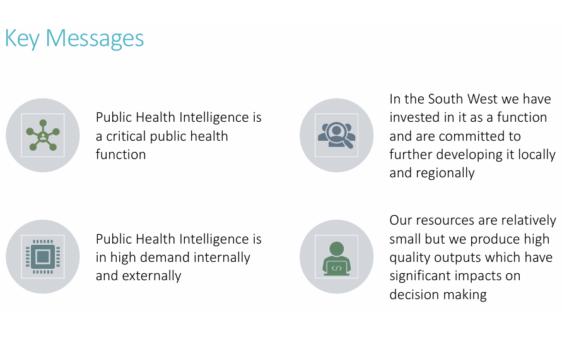
The review confirms that the South West has strong, skilled and influential PHI teams, delivering high‑impact intelligence despite increasing demand, limited capacity and significant variation in team structures, roles and data access. While leadership and analytical capability are key strengths, the report identifies opportunities to improve consistency, collaboration, co‑production and data architecture across the region.
The report sets out clear priorities for improvement, focused on four areas:
- Strengthen workforce sustainability through shared career pathways, skills development and regional leadership via a re‑established South West PHI Leads Group
- Increase impact and consistency by sharing best practice, improving intelligence storytelling and supporting weaker areas such as co‑production and data infrastructure
- Deepen system relationships, particularly across ICB clusters, local authorities, VCSE partners and academia to support joined‑up population health intelligence
- Improve data access and governance through shared resources, minimum regional standards and collective action to reduce access barriers
Delivery of these recommendations will be taken forward collaboratively through SWINPHO and regional PHI leadership, ensuring intelligence continues to inform better decisions and improve population health outcomes across the South West.
National Recognition
The programme methodology and learning were showcased nationally at the Local Government Association / Association of Directors of Public Health Annual Public Health Conference 2026.
A South West‑led session, “Influencing with Intelligence: Strengthening the Role of Public Health Intelligence Through Practice Improvement”, showcased the South West’s commitment to using high-quality intelligence to drive better outcomes, improve local decision-making, and build system-wide capability through structured practice improvement. The presentation was extremely well-received and highlighted the region’s collaborative strengths, innovation, and leadership in embedding intelligence-led approaches across public health practice. You can view their presentation slides on the